
Bring hope to forgotten conflicts
15 June 2026
Arsen is an independent journalist from Nagorno Karabakh, now based in Armenia. He has cerebral palsy and has been associated with the Lady Cox Rehabilitation Centre for many years. His reporting focuses on displacement, inclusion and the experiences of communities affected by conflict.
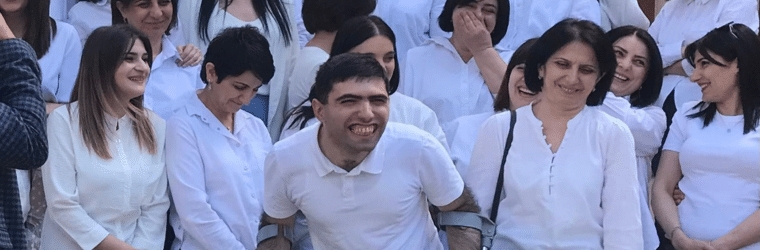
PHOTO CAPTION: Arsen (front, right) with the team at the Lady Cox Rehabilitation Centre.
My name is Arsen. I was born in Stepanakert, in the heart of Nagorno Karabakh (Artsakh). In 1988, my family, like the entire Armenian population of Azerbaijan, was forcibly displaced by ethnic cleansing. They were forced to leave everything they had built over decades and flee to our ancestral homeland, seeking safety in Artsakh.
My parents witnessed the horrific atrocities committed against Armenians. They often told me how Azerbaijani mobs went door to door looking for Armenians, killed civilians, raped women and even burned people alive. I listened to these stories with horror, not imagining that the same fate would befall me.
I survived three wars, a brutal blockade and another round of ethnic cleansing.
After the 2020 war, life in Artsakh has never been the same. The aftermath was everywhere – destroyed buildings, separated families, and an oppressive silence on the faces of people who had once smiled with hope. It was common to see young people walking with canes, on crutches, or confined to wheelchairs on the streets of Stepanakert. Many had lost limbs; everyone had lost something.
I was working at the Lady Cox Rehabilitation Centre at the time. Hundreds of wounded veterans of the 44-Day War came to us seeking physical and psychological healing. Tourism had almost completely stopped, and most of Artsakh was now occupied. Even a family picnic required careful consideration of safety – no place felt safe anymore.
And then came the blockade. We were cut off from the outside world. Electricity was limited by rolling blackouts. We waited in endless lines – sometimes thousands of people – for a single loaf of bread. Without fuel or public transport, we walked for miles, even in freezing temperatures, just to get to work. Coffee, a small consolation, was made from chickpeas and chicory. Food was rationed, and families had to share their meagre portions with neighbours, relatives, and colleagues.
On weekends, if we were lucky enough to have electricity for a few hours, we would gather at home with friends. Sometimes we managed to make lamb shashlik – lamb and beef were the only meats available on ration cards. I had never liked lamb before, but on those days I ate it with gratitude.
In the last days of the 2023 blockade, we began preparing for the harsh winter. Together with friends and family, we began to collect firewood. We took care of the land, planting carrots, beets, greens, and other vegetables. But we never managed to harvest them. We were forced to flee again – this time for good.
Now my family and I live in Yerevan, in a rented apartment. We carry with us the trauma, the loss, and the memories of a homeland that is no longer ours.
Today, I stand before you not only to tell my story, but also to call upon you: recognise the suffering of the people of Artsakh. Recognise the ethnic cleansing we have endured. Recognise that what happened to us should never happen again – to any people, anywhere.
Throughout the grief of displacement, the Lady Cox Rehabilitation Centre has been a source of hope and comfort for Arsen. He reflects on the profound impact of the Centre on his life and the lives of other families who were displaced from Nagorno Karabakh:
The Centre is my second family. I am very thankful for the amazing team. They are doing an important job for people of Armenia and Artsakh (Nagorno-Karabakh), and personally for me.
Read more about the impact of the Lady Cox Rehabilitation Centre on the lives of people with disabilities, their families, and refugees from Nagorno Karabakh who are now living in Armenia.